Showing posts with label HONDA. Show all posts

Thursday, 6 June 2013

Result : Suzuka 8H Official test..

Suzuka 8 Hours Official Test Day 1 combined results.
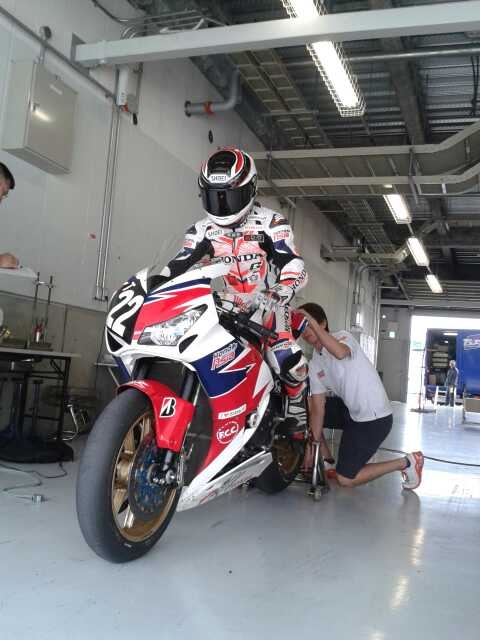
Tamada #022 clocked the 4th fastest time of the day, meanwhile Azlan #22 could only go 13th fastest after he high sided in Session 1.


Azlan Shah in action at Suzuka before he high sided during Session 1 of the Suzuka 8 Hours Endurance Official Test.

Photo credit to Hiroyuki Wakita.


Tamada & Azlanshah confirmed for Suzuka 8 Hours

Makoto Tamada has been confirmed to ride with #22 Honda Team Asia at the prestigious Suzuka 8 Hours Endurance Race this year.  This is Tamada’s second year to ride with the team.
Tamada will be teaming up again with his Asian Championship teammate, Azlan Shah Kamaruzaman.  The third rider has not been announced.
Tamada and Azlan will be riding the Honda CBR1000RR with Bridgestone tires.
Entry:  Honda Team Asia
Number:  #22
Teammate: Azlan Shah Kamaruzaman
Machine: Honda CBR1000RR
Tires: Bridgestone
Comment, Makoto Tamada
“I am happy to be racing at Suzuka again this year with Honda Team Asia.  I am also happy that Azlan is once again my teammate.  He has improved a lot since last year, and I hope I can bring out the best and the speed that Azlan has.”

Wednesday, 5 June 2013

FOR SALE : HONDA CB4 VTEC CAFE RACER

Selling cheap my Honda CB4 VTEC  converted to a Cafe Racer. Running condition. Boleh ride ke Art of Speed this weekend. Documents complete.(Singapore Registered) Asking for RM10,000.00 Nego. Call 0105465444 atau boleh dtg terus ke SBM/CBC Desa Pandan for viewing/testing.


Thursday, 30 May 2013

Azlanshah@JSB

Azlan Shah #25 akan beraksi dalam All Japan minggu ini di Autopolis dalam kelas JSB1000 diatas tiket wildcard.. beliau akan menggunakan no #78 jentera CBR1000 pasukan honda asia.. sama2 kita mendoakan beliau memperolehi kejayaan disana hujung minggu ini..

credit :- motogp mania malaysia


Monday, 20 May 2013

Pedrosa wins drama-filled race at Le Mans

Dani Pedrosa has become the first rider to win two races in the 2013 MotoGP™ season, coming from sixth position on the grid in mixed conditions at Le Mans. He now leads the championship from Repsol Honda Team partner Marc Marquez, who fought to the podium after a poor start as Britain’s Cal Crutchlow finished second.


For the second year in succession, the field was presented with a wet track for the start of the Monster Energy Grand Prix de France. All competitors duly elected to fit the Soft compound wet weather tyres for both front and rear wheels, although this resulted in an extremely difficult final handful of laps as the tarmac dried out.
Pedrosa’s ride to a first victory at Le Mans in the premier class was a calculated but exciting one. Having crashed in qualifying, he stayed out of trouble at the start and passed Yamaha Factory Racing’s Jorge Lorenzo. The Honda rider then caught Ducati Team’s Andrea Dovizioso, who had fought into the lead from a front row start and continually re-passed Pedrosa whenever the latter made a mistake. The final swapping of places came at half distance.
The weekend has been a memorable one for Crutchlow. On Saturday the Englishman sustained a fracture to the top of his shin bone, causing immense pain in the knee, but from fourth on the grid he made the most of the mixed conditions and stormed passed old teammate Dovizioso in the closing stages. The Ducati rider led for a chunk of the race and ultimately just missed out on a rostrum result as Marquez - championship leader heading into the day - fought back from a poor getaway and a selection of off-track moments. He therefore maintains his 100% podium finish record for 2013.
Nicky Hayden confirmed Ducati’s strongest day of the campaign to date by finishing fifth from GO&FUN Honda Gresini’s Alvaro Bautista, but it was a somewhat disastrous afternoon for Yamaha Factory Racing. Lorenzo struggled to make an impression and slid down the order to seventh, whereas Valentino Rossi - who had previously battled with his teammate - fell while under pressure from Hayden. The Italian recovered to 12th behind Pramac Racing’s Andrea Iannone, whose temporary teammate Michele Pirro rose to eighth ahead of Tech 3’s Bradley Smith.
Aleix Espargaro again celebrated the top CRT spot in 13th, although the Power Electronics Aspar rider had to fight past Came IodaRacing Project’s Danilo Petrucci and took advantage of a crash for teammate and local favourite Randy de Puniet. Bryan Staring (GO&FUN Honda Gresini), Claudio Corti (NGM Mobile Forward Racing), Lukas Pesek (Came IodaRacing Project) and Yonny Hernandez (PBM) also all retired but no rider suffered injury.
Pedrosa’s fourth win in France across the three classes makes him the championship leader, as the 2012 runner-up is now up to 83 points and six ahead of teammate Marquez. Honda leads the Constructors’ Championship from Yamaha by 14 points, with Repsol Honda Team now 47 ahead of Yamaha Factory Racing for Teams’ honours. The battle will continue at Mugello in Italy on 2ndJune.

Friday, 17 May 2013

dani anime


Pedrosa maintains leading form in France

Fresh from his win in the Spanish Grand Prix, Dani Pedrosa topped both Friday practice sessions at Le Mans ahead of the Monster Energy Grand Prix de France. The Repsol Honda Team rider led teammate Marc Marquez and Yamaha Factory Racing’s Valentino Rossi as less than three tenths of a second covered the top five riders.


Heading into the afternoon session, there was a sense of urgency to seal top ten positions for Q2 Qualifying as rain is forecast to hit the iconic venue on Saturday. Pedrosa led with 1’34.035 as the top eight riders of the afternoon beat the leading lap time of the morning period. Behind Marquez and Rossi, Yamaha’s world champion Jorge Lorenzo and LCR Honda MotoGP’s Stefan Bradl completed the top five.
Cal Crutchlow led the Monster Yamaha Tech 3 charge from sixth position as teammate Bradley Smith took a pair of almost identical trips through the Dunlop gravel trap across the opening couple of sessions. There was a worse moment for Energy T.I. Pramac Racing’s Andrea Iannone, who ended the day in 12th place after suffering an accident on the exit of Raccordement, the final corner of the lap. On the Ignite Pramac Racing bike, Michele Pirro is standing in for the recovering Ben Spies, while Karel Abraham is back in action for Cardion AB Motoracing.
The top ten was rounded out by Ducati Team duo Andrea Dovizioso and Nicky Hayden plus GO&FUN Honda Gresini’s Alvaro Bautista and Power Electronics Aspar’s Aleix Espargaro - the leading CRT runner. Teammate and home rider Randy de Puniet ended the day 13th quickest. Came IodaRacing have switched from a chiefly white to black livery, whereas NGM Mobile Forward Racing’s Claudio Corti experimented with a new air in-take on his FTR Kawasaki.
If third practice eventually takes place amid dry conditions, the riders will have one final chance to confirm a guaranteed Q2 position by finishing in the overall top ten from across the opening trio of practice periods. Should they fail to do this, another chance will come as the top two riders from Q1 will join the top 12 shootout for pole. Saturday’s FP3 session starts at 9:55am local time (GMT +2).

Pedrosa on top of first Le Mans practice


Jerez race winner Dani Pedrosa has maintained his form by topping Friday’s first practice session for the Monster Energy Grand Prix de France. In completely dry conditions, the Repsol Honda Team rider led Yamaha Factory Racing duo Jorge Lorenzo and Valentino Rossi.

Lapping in 1’34.645 at the iconic Le Mans Bugatti Grand Prix circuit, Pedrosa edged out world champion Lorenzo by just four hundredths of a second, with Rossi a further two tenths adrift. As planned, Lorenzo used Yamaha’s new spec chassis and Rossi the older one. Nicky Hayden was fourth on the leading Ducati Team bike - less than half a tenth slower than Rossi - as teammate Andrea Dovizioso completed the top five.
A problem-free morning for Cal Crutchlow saw the Monster Yamaha Tech 3 man into sixth position, narrowly beating Repsol Honda’s Marc Marquez who is the sole championship leader following his last-corner touch with Lorenzo in Spain. This morning’s top ten was completed by GO&FUN Honda Gresini’s Alvaro Bautista, LCR Honda MotoGP’s Stefan Bradl and Avintia Blusens’ Hector Barbera as the leading CRT runner. Both Bautista and Barbera ran with new front springs.
En route to 15th spot, Tech 3’s Bradley Smith escaped a trip through the gravel at Dunlop, whereas Michele Pirro - substituting for the recovering Ben Spies at Ignite Pramac Racing - coasted back to the pits with a technical problem. In 21st place, Karel Abraham was returning for Cardion AB Motoracing, having been hurt in a Texas crash and requiring seven screws and a plate in his right shoulder.
As the best lap times from practice decide which riders head directly in Q2 Qualifying, this afternoon’s second session will be critical as a 70% chance of rain is predicted for tomorrow. The action resumes at 2:05pm local time (GMT +2).


Wednesday, 15 May 2013

Idemitsu Honda Team Asia establishes riding school

Idemitsu Honda Team Asia has relocated to France and, in doing so, launched a collaboration with CIP in order to create a riding school dedicated to Asian riders.


On Monday, the Moto2™ outfit staged a presentation at AlĆØs PĆ“le MĆ©canique in France - the country in which the team has been located since March of this year. The new riding school will be overseen by former Grand Prix rider and team manager Tady Okada.
‘The idea is to create a riding school dedicated to Asian riders,’ the squad explains via an official press release. ‘This school should allow the riders to come to Europe and help them to develop the necessary skills to become Grand Prix riders.’
At the end of the presentation, Idemitsu’s Yuki Takahashi and was joined by CIP Moto3 rider Alan Techer for an on-track display.


Say Hello to the 2013 Honda…Grom?


We already covered the Honda MSX125 monkey bike when it debuted at the start of this year, and at the time we knew that the tiny street-terror would be a world market machine. Confirming our hopes at the time of its launch, Honda Motor Corp. has announced that it intends to bring the MSX125 to the United States, renaming it the Honda Grom.
The 2013 Honda Grom will come with just under 10hp, and features a four-speed gearbox that is mated to a 125cc single-cylinder motor, which comes from the common-parts bin of the Japanese company’s popular Honda Wave 125i scooter. Fuel-injected, 225 lbs at the curb when topped-off with its 1.45 gallons of fuel, and priced at $2,999 MSRP, we think Honda hit its mark with an affordable, bulletproof, and fun grocery-getter.
Track day enthusiasts, we have found your perfect pit bike; new riders, we have the ideal machine for you to cut your teeth on, while still being “cool” in the eyes of your more experienced riding friends; and for those who are vertically challenged, your 29.7 inch inseam machine is ready. More photos after the jump, but note America will only be getting the red & black models.
Model:Grom125
Engine Type:124.9cc air-cooled single-cylinder four-stroke
Bore and Stroke:52.4mm x 57.9mm
Compression Ratio:9.3:1
Valve Train:SOHC; two valves per cylinder
Induction:PGM-FI with automatic enrichment
Ignition:Electric
Transmission:Four-speed
Final Drive:Chain
SuspensionFront: 31mm inverted fork; 3.9 inches travel
Rear: Single shock with steel box-section swingarm; 4.1 inches travel
BrakesFront: Single 220mm disc with hydraulic dual-piston caliper
Rear: Single 190mm disc with hydraulic single-piston caliper
TiresFront: 120/70-12
Rear: 130/70-12
Wheelbase:47.4 inches
Rake (Caster Angle):25° 0’.
Trail:81mm (3.2 inches)
Seat Height:29.7 inches
Fuel Capacity:1.45 gallons
Fuel Economy Estimate**:TBD
Colors:Pearl Red, Metallic Black
Curb Weight*:225 pounds
*Includes all standard equipment, required fluids and full tank of fuel—ready to ride.
**Miles per gallon values are calculated estimates of fuel consumed during laboratory exhaust emissions tests specified by the EPA, not during on-road riding. Use for comparison purposes only. Your actual mileage will vary depending on how you ride and maintain your vehicle, weather, road conditions, tire pressure, cargo and accessories, rider and passenger weight, and other factors.
Meets current CARB and EPA off-road emissions standards.

Different challenges for Marquez and Pedrosa

World Championship leader Marc Marquez heads to Le Mans with the added task of needing to learn a new circuit on MotoGP™ machinery. As for Repsol Honda Team partner Dani Pedrosa, he is striving to end a winless French run in the top class.


If either of the riders triumphs in the Monster Energy Grand Prix de France, they will become the first repeat winner of the 2012 campaign. Before thinking about such achievements, however, 20-year-old Marquez will be learning in free practice.
"We go to Le Mans and again we arrive there starting from zero, as I haven't done any tests there," he explains. "I'll do my best and I'll try to make the most of the situation. I hope it doesn't rain so we can prepare the bike on a dry track; this is very important in order to find the right setup.
"I'm very happy at the moment but we have to keep our feet on the ground, as the coming circuits are new for me in MotoGP. A huge part of our success in this first part of the season is down to the help that Honda and the team have given me and it had helped my riding a lot."
Pedrosa has reason to be confident ahead of the weekend, having won the last Grand Prix at Jerez. In terms of victories at Le Mans, the elder of the two Spaniards has celebrated success on three occasions in either the 125 or 250 classes.
"After a fantastic weekend in Jerez and a productive test on the Monday, I'm looking forward to going to Le Mans," Pedrosa comments. "I have had good results in the past and I enjoy the circuit, so I'm hoping that the bike works well there.
"Practice management in Le Mans can sometimes be difficult and complicated due to the weather, but I'm finding my comfort again on the bike and I'm working well with the team. I will go to France and aim to use all of my experience and remain focused for the whole weekend."
Marquez, who won in Moto2™ for the first time at Le Mans in 2011 but crashed out last year, currently leads MotoGP™ by three points from Pedrosa. Reigning champion Jorge Lorenzo (Yamaha Factory Racing) is four points in arrears of the leader following their high profile collision at the end of the Spanish Grand Prix.

Tuesday, 14 May 2013

MotoGP Le Mans: Title leader Marquez 'starting from zero’


MotoGP rookie Marc Marquez begins this weekend's French round on top of the world, after claiming 3-1-2 results in the opening races of his premier-class career.

The 20-year-old's runner-up finish at Jerez came at the expense of world champion Jorge Lorenzo, whom Marquez dramatically barged past at the final corner of their home race.

Victory in Austin proved Marquez already has the speed and mental stamina to win in MotoGP, whileJerez proved he is unafraid of upsetting the established stars. A potent mix.

"We go to Le Mans and again we arrive there starting from zero, as I haven't done any tests there,” said Marquez, whose Qatar third came at a circuit he had not previously tested his RCV at. 

“I'll do my best and I'll try to make the most of the situation. I hope it doesn't rain so we can prepare the bike on a dry track, this is very important to find the right set up. I'm very happy at the moment but we have to keep our feet on the ground as the coming circuits are new for me in MotoGP.”

Marquez - fastest at the post race Jerez test - starts round four with a three-point lead over Repsol Honda team-mate Dani Pedrosa, the winner at Jerez. Yamaha's Lorenzo is four-points from Marquez. 

Each of the Spanish trio has won one race this year.

MotoGP Le Mans: Pedrosa takes victory momentum to France


Beaten by rookie team-mate Marc Marquez in the first two MotoGP events of this season, Dani Pedrosa served a reminder of his talents by winning in front of his home fans last time at Jerez.

Pedrosa's victory means Honda has now won 12 out of the last 15 races, while Marquez and Pedrosa have moved into first and second in the 2013 title chase.

"After a fantastic weekend in Jerez and a productive test on the Monday, I'm looking forward to going to Le Mans,” said Pedrosa, who is yet to win at the French circuit in the premier-class but took three victories in the lower categories.

“I had good results in the past and I enjoy the circuit, so I'm hoping that the bike works well there.

“Practice management in Le Mans can sometimes be difficult and complicated due to the weather but I'm finding my comfort again on the bike and I'm working well with the team.

“I will go to France and aim to use all of my experience and remain focused for the whole weekend."

Pedrosa, the 2012 title runner-up, is just three points behind Marquez and one point ahead of Yamaha's Jorge Lorenzo.

Monday, 13 May 2013

Kawasaki Ninja 300 vs. Honda CBR250R

Last decade the entry-level sportbike class in the United States was a one-bike show. Novice riders could have any bike they wanted, as long as it was Kawasaki’s Ninja 250. Now as manufacturers clamor for market share of coveted new riders, the once stagnant beginner bikes are finally benefitting from R&D attention. The result for consumers is a more robust offering of small-displacement mounts, with the promise of more on the way (see sidebar). 

Kawasaki’s Ninja 250 reigned unchallenged for years as thequarter-liter sportbike in America. It faced zero direct competition from Kawasaki’s Big Four rivals, despite the little Ninja’s obvious popularity. Instead, manufacturers seemed content to chase the higher margins afforded by the larger displacement Supersport and Superbike classes. Then the motorcycle market crashed, with the sportbike segment high-siding… Now as the market stabilizes, more manufacturers see wisdom (or is it necessity?) of producing fun, affordable bikes to court a new generation of riders. 

Honda was the first to challenge Kawasaki with its CBR250R. The 2011 model year debut showcased some of Honda’s engineering might – with features like the off-set cylinder head on its liquid-cooled Single. It also offered big-ticket newbie-friendly features like optional ABS and linked braking. While it thankfully provided sportbike initiates with a second option, it couldn’t displace the Kawasaki in our 2011 CBR250R vs. Ninja 250R comparison.  

Two years after the CBR affront, Kawasaki delivers its Ninja 300, powered by a now-296cc Parallel Twin. Those extra 47 cubes impressed during the 300’s First Ride introductionlate last year. But the other redesign changes and additions on the Ninja, like its slipper clutch, make this Kawasaki a comprehensively better bike than its predecessor. 

The above statement doesn’t bode well for the Honda, of course, but the CBR showed true Samurai spirit by not flinching in this 2013 comparison test. Down 47cc, the CBR squared off against its bigger Ninja rival in MotoUSA’s standard showdown format. Our test kept to the streets (in hopes that we may follow up this year with a track test), with a mix of freeway, city and canyon carving duties surrounding our offices in Southern California. We ran the little rippers on the in-house dyno and weighed them on the scales, as well as gathered the usual performance test data as best we could.

As author of the Ninja 300 First Ride and well-versed with the previous 250 iteration, I serve as author and chief test rider alongside our do-it-all editor/video guru Justin Dawes. Chasing my colleague on Ortega Highway with the throttle pinned, my little CBR screaming at redline… we were far from a triple-digit pace, but both of us were grinning. True, these entry-level bikes are a critical segment for the motorcycle industry. But they also deliver a legitimately fun riding experience. Here’s what we discovered. 

It’s no surprise the brave little CBR250R takes some knocks in this shootout. It fell short to the Ninja 250R two years ago, so there was little hope of besting a more refined 300. But like a scrappy fighter punching above its weight, the Honda acquits itself well as an entry-level commuter, and even lands a couple performance shots against the bigger brawler. 

The CBR’s obvious deficit comes from the 47cc disparity of its 249cc liquid-cooled Single. On the MotoUSA dyno it registered 23.75 peak horsepower and 15.66 lb-ft of torque - giving up a staggering 11.66 horsepower to the new Ninja. Against the older Ninja 250, the CBR’s Single also lacked peak top-end power, but it countered with more pleasing torque down low. Against the 300, however, the Honda faces a sizable power deficit across the entire rev range. It only comes close to catching the 300 with its mid-range kick, around 6000-8000 rpm, and even then gives up a couple ponies. After 8K the CBR signs off and watches the Ninja make tracks with its robust top end. 

Riders don’t need a dyno to determine the more powerful mill on the street. The CBR’s bottom end, formerly its saving grace, now feels lackluster compared to the much-improved Ninja. The Honda’s acceleration data says it all, as our test rider required an extra 2.58 seconds to get up to 60 mph. And once on the move the CBR can’t match the Ninja in roll-on power, as it struggles to keep its green rival in the crosshairs. The performance gap was particularly notable on the freeway, during inclines and when gassing out of a corner. 

“The Honda’s power is lacking in comparison to the Ninja as you would expect,” admits Justin. “Even so, it still is pretty peppy for a 250cc Single. Keep it spinning and the little quarter-liter Honda will scoot.” 

The Single does make for an easy-to-ride powerplant, and only in comparison with the now-larger Ninja does it seem timid. As a stoplight-to-stoplight commuter its tractable powerband and low gearing excels. Seamless fueling and a forgiving throttle response ensure newbies aren’t overwhelmed either. However, the CBR’s EFI advantage is now canceled out by the once-carbureted Ninja’s upgrade to fuel injection. 

Engine vibration is another area where the CBR gives ground, owing to the Ninja’s improvement. Where the Honda was once praised for smoothing out the inherent vibes produced by a Single (thanks to its gear-driven counter balancer), by making the Ninja’s Twin less buzzy, Kawasaki shifts the vibration disadvantage back to Honda. For what it’s worth, the single-cylinder CBR does emit more polite exhaust tones, registering 82 dB at idle and just 91 at half-redline (5250 rpm) - compared with an 88/97 dB registry from the Kawasaki. 

“The CBR’s mill revs slower and just doesn’t have any sort of rush,” says Justin. “It’s acceptably smooth unless you let your knees touch the bike, then you realize how well the footpegs and handlebars are dampened.” 

A well-sorted six-speed transmission makes for easy launches, with the Honda offering a light clutch lever pull. Our testers find no serious fault with the Honda transmission, but the Kawasaki’s clutch provides smoother engagement. 

“While the CBR shifted just as well as the Kawasaki, the clutch just didn’t have the feel and actuation of the Ninja. Not a deal killer for sure, it just wasn’t quite as good,” rates Justin. 

here’s also the matter of the slipper functionality offered by the Ninja's clutch – a clear advantage for the Kawasaki. The CBR does nothing wrong or unexpected, but bang thru the gears with an ill-advised downshift and the rear end will hop, skip and chatter where the Ninja’s does not. 

But it’s not all doom and gloom for the plucky Honda! Our testers deem the CBR brakes superior to the Ninja, despite a 60-0 braking evaluation that actually shows it at a slight disadvantage (143.4 feet to 141.8). Both mounts feature single-disc fronts, but the Honda’s Nissin calipers deliver a more forceful initial bite and enhanced lever modulation. The CBR’s ABS and linked braking also feels more effective in action. The back-to-front linked system may not be favored by all, including our dirt-oriented editor, but the newbie-friendly feature does settle the front end for a controlled stop. 

“Although I’m not a fan of linked brake systems or ABS,” admits Justin, “the CBR brakes bring you down from speed with excellent power and better-than-expected feel.” 

Lightweight handling and easy flickability are two more areas where the CBR shines. Its 366-pound curb weight scrubs a full 20 pounds from the Ninja, but we'd guess the sprightly Honda even lighter by the way it hustles. A physically narrower bike, the slender CBR sports a 1.4-inch shorter wheelbase (53.9 inches) and two-degree steeper rake (25.0 degrees). This geometry translates into a sharp-cutting ride when the road kinks up. 

“The Honda was so light and flickable in the turns, and for me that was the deciding factor,” says Justin. “On the bigger bumps the chassis would protest, but the trade-off on the tight mountain roads was worth it.” 

A non-adjustable 37mm conventional fork holds up well in slash-and-dash maneuvering, but starts to flex when pressed hard. Quick to turn in but twitchier as well, the nimble CBR gains agility at the expense of high-speed stability – where the larger Ninja fares better. 

The dimensions of the Honda make for a more compact cockpit, ideal for shorter riders. A 30.5-inch seat height makes for an easy reach to the ground, but taller riders will find the footpegs cramped. 

“The Honda is a smaller machine all over and would definitely be my choice if I were a small statured rider,” reckons Dawes, adding: “If I could have taken the CBR’s seat with me when it was time to ride the Kawasaki, I would have.” 

Both MotoUSA test riders agree the Honda’s cush seat is far comfier than the Ninja’s stiff perch. We also found the CBR’s bodywork and windscreen, while less encompassing, to be quite effective. These two aspects make the Honda our preferable mount for pounding out freeway commutes. 

Honda fit and finish is evident in the levers and controls, and the CBR feels sturdy and well made. However, the instrument console already looks dated, particularly compared to the new Ninja. Another gaffe is the fuel cap, which fully detaches from the tank instead of retracting up. While more of a chore to fuel up, the CBR does deserve credit for its more miserly fuel usage. We observed a 58.7 mpg fuel efficiency aboard the Honda, with the Kawasaki measuring 53.2 mpg. Forced to ferry the 200-plus pound weights of our test riders, the Honda should net well over 60 mph for lightweight riders and more forgiving throttle hands. 

Frugality at the pump extends to pricing, where the CBR makes its most impassioned case to consumers. The 2013 model bumps MSRP up $100 to start at $4199, with our ABS model ringing in at $4699. Honda undercuts the base model Ninja 300 by $600, with the ABS version an even tidier $800 value. Kawasaki will counter that the performance gains offset the pricing disparity, and we’d agree. But a budget-minded newbie or commuter can beg to differ, with justification. 

In this comparison the Honda clearly suffers from its 47cc displacement handicap, but there’s much to hail about the humble CBR. Riders should praise its cost-effective fun and utilitarian functionality. Most important for consumers, the once moribund entry-level class has been stoked up by this little 250’s challenge. 

Kawasaki answered Honda's CBR250R volley with a full-salvo of its engineering might. Team Green’s littlest Ninja hasn’t exactly been a fresh face over the years, going virtually unchanged for two decades until a redesign for the 2008 model year. Even then the 250R retained its old carbs to keep costs down, befitting of a bike designed during the Reagan administration. This new Ninja 300, however, is a complete overhaul – and a far superior design than its predecessor.

The Ninja’s 296cc Parallel Twin outperforms the CBR Single to a shocking degree. Those 47 extra cubes reflect a 19% increase in displacement, but deliver 49% more peak horsepower. Sure, the Kawasaki is an unrepentant displacement cheater (just like the 636cc ZX-6R), but it does a fine job of it! 

“It’s really no contest; from the bottom all the way until redline the Kawi spanks it’s competition. With the 300, highway work is no longer a scary proposition,” states Justin. 

There’s no measure of engine performance where the Ninja doesn’t earn an easy win. Acceleration and roll-on power, it’s no contest – not even close. Low end torque, it has the CBR covered, easily. And that’s its weakest area. Once the familiar top-end biased power curve of the old 250 asserts itself, the new 300 takes off. It’s like the old Ninja, plus seven to eight horsepower – everywhere. It still prefers to have its neck wrung up at the top end, near the pleasingly high 13,000 rpm redline, but unlike the previous 250 it doesn’t demand that it be flogged. Riders can now putter along lower in the rev range without trouble, if they so choose. 

On the street the Ninja outpaces the CBR at will. Uphill sections saw the Ninja rider easily check out, while the CBR pilot struggles to keep pace. Same goes with corner exit and passes on the freeway/highway. Any twist of the right wrist sees the Kawasaki rider enjoy an advantage. 

In virtually every aspect, the Ninja has improved. Engine power, yes, that’s far superior – to belabor the point... But the power delivery itself is more refined. The new electronic fuel injection is smooth, and the throttle is lively without being herky jerky. 21st century riders will appreciate the ditched choke and carbs that adorned the previous 250, as this 300 fires up immediately sans any fueling hiccups. 

The 300 also features a notable reduction of engine vibration. The previous Ninja was a buzzy ride, with vibes rattling up into the tank and bars. The revised 300 quells that buzz, with the few escaping vibes nominal – less noticeable than the CBR at any rate. 

A six-speed gearbox is on par with that found on the Honda, but the Ninja goes one better with its F.C.C. clutch featuring assist and slipper functionality. Justin notes, “the clutch feel from the Kawasaki was slightly better from a standstill than the CBR, and it shifted smooth and without issue during our time on it.” 

The slipper clutch is a boon for the Ninja’s user-friendliness. Where aggressive downshifts on the CBR are met with unsettling tire chirps or worse, the Ninja’s drivetrain exhibits no hint of stress or traction loss. 

Turn-in on the Ninja is slower than the eager CBR, but not by much. And saying the CBR is more flickable does not imply the Ninja is a slug! Nor do those extra 20 pounds added to the 386-pound Ninja make it feel portly. The Kawasaki is eager to attack ribbons of asphalt, and its tauter chassis better handles high-speed sweepers. 

“Kawasaki would be my choice thanks to the more settled suspension,” says Justin. “It soaked up the road’s imperfections better. However, the steering was a tick slower than the Honda and it took slightly more effort to change direction.” 

A slightly longer wheelbase and compliant suspension make for a composed ride – as the Kawasaki better absorbs potholes and road imperfections. If the Ninja had a forgiving seat, it would easily be the more comfortable mount, particularly since its ergonomics better suited our test rider’s larger dimensions. As it stands – or sits – the Ninja’s seat felt awful compared to the softer CBR perch – though the extra legroom and relaxed riding position are appreciated.

“The larger chassis of the Ninja 300 will fit a larger variety of riders,” explains Justin. “There is more legroom and the rider’s triangle seems more relaxed. While the seat was much harder than the CBR, the increased legroom made long days in the saddle more bearable.”

The Kawasaki’s brakes left us flummoxed. In past comparisons the 250 Kawasaki rated highly, but the 300’s front stopper left much to be desired. Both the Honda and Kawasaki source a single-disc front, but the Ninja’s offered notably less bite and feel than the stout Honda. 

“The front brake on the Kawasaki felt mushy on the street. Perhaps it was in need of a bleed, but as it was the braking was less than stellar,” agrees Justin. 

Honda still gets a leg up on fit and finish, particularly the controls and levers. But the instrument console is an easy win for the Kawasaki. The CBR display looks clean enough, but certainly is cast appropriately aboard a budget sportbike. The Ninja, meanwhile, sports a clean, easy-to-read display with large analog tach and right-side LCD display featuring digital speedo with tripmeters, clock and fuel gauge. It’s everything a rider needs. 

“The instrumentation on the Kawasaki looks like it came off a Ninja ZX-6R or ZX-10R,” reckons Justin. “The rev counter is slightly easier to read than the Honda.”

The CBR indeed nets an extra 5 mpg in fuel efficiency. However, the Ninja offsets this with its 1.1-gallon larger fuel load. At the 53.2 mpg we observed its 4.5-gallon tank should stretch out a 239.4-mile range – almost 40 more miles than the Honda. 

Styling for the 300 does a laudable job mimicking its larger Ninja siblings. The green/black special edition livery didn’t really click with our testing crew, which preferred the red/white/blue lines of the CBR – but we’ll defer the styling debate as a matter of personal taste. The 300 does look more like a big-boy/girl bike than previous entry-level Ninjas, and the displacement moniker is notably absent from the bodywork. 

The 300’s premium look and performance comes with a corresponding price tag - $4799 for the base model, with the as-tested ABS version $5499. In ABS trim the Ninja 300 is $800 more than the CBR250R, and $600 more in non-ABS standard mode. The pricing disparity is almost as much as the forthcoming Honda CBR500R, which retails for $1000 more than Ninja 300 ABS and $1200 standard. As silly as a displacement war sounds for the entry-level class, Kawasaki may get a dose of its own medicine if consumers deem the CBR500 a better value. But that assumption depends on the performance of the 500, as it may just prove the new little Ninja’s true potency – and we’d reckon the Ninja 300’s performance on par, at least, with the old Ninja 500. 

But that 300 vs. 500 challenge will have to wait for a future comparison… In this review, there’s no match for the Ninja 300. 

FOR MY MONEY PICKS:

Justin Dawes – Kawasaki Ninja 300 
“It’s really a no brainer for me which bike I would go for here. The Kawasaki smashes the CBR in terms of performance. It’s not even a contest at anytime. While the CBR can get into corners better, it makes no difference when the Ninja just blasts past it with ease on the exit. On the highway and commuting, the littlest Ninja feels like a large bike with enough oomph to move through traffic. Now the real question is - how will it compare to the CBR500R?” 

Bart Madson – Kawasaki Ninja 300 
“The Ninja 300 bests the CBR with its impressive engine performance. I expected as much after I first rode it last year, but the side-by-side comparison surprised me by how just much it covers the Honda. The Ninja 250 was already a favorite, and the 300 pretty much fixes all my complaints on the previous model. Fuel injected and no more buzz at the tank and pegs, and a slipper clutch… the poor CBR really had the cards stacked against it.

"Aside from the Ninja's uncomfortable seat and weak, by comparison, brakes – there’s not a whole lot to gripe about! Except price, yeah, I’ll gripe about that. It’s a better bike for sure, but I remember that 2007 Ninja 250 was just $2999. Our 2013 Ninja test bike featured ABS and slipper clutch, but the cost of entry for Kawasaki sportbikes has nearly doubled within a six-year span. Improved performance is great, but manufacturers need to ensure prices remain affordable.”

http://www.motorcycle-usa.com/9/15984/Motorcycle-Article/Kawasaki-Ninja-300-vs--Honda-CBR250R.aspx